
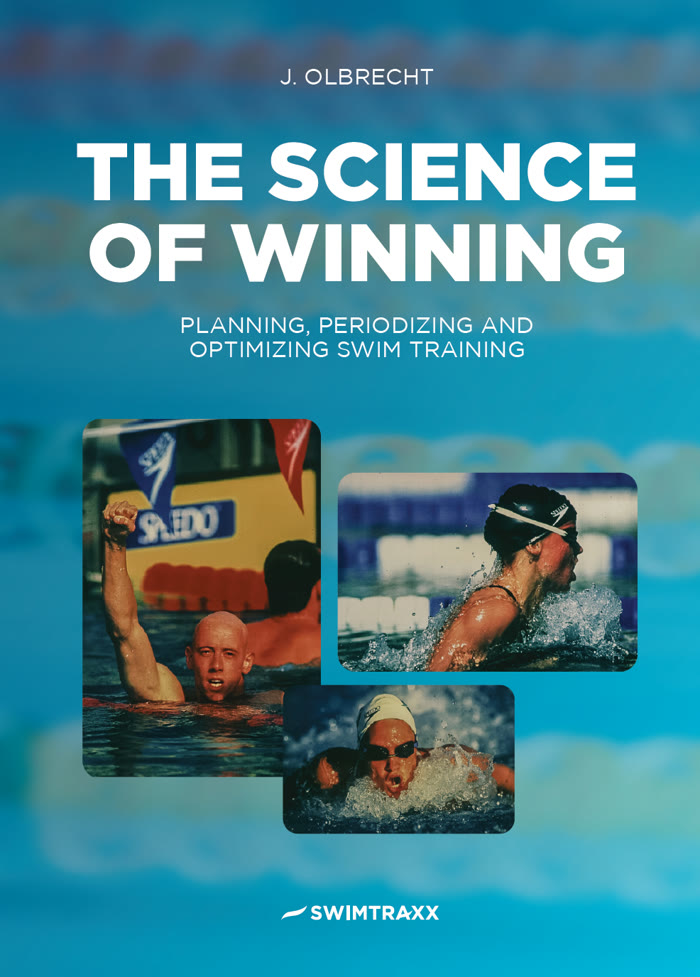
The Science of WinningPlanning, Periodizing and Optimizing Swim Training
The famous training guide for swim coaches, now in its third edition. Jan Olbrecht explains what training really does to a swimmer, how to steer it with lactate tests, and how to plan and periodize a season around it. Order your copy below, we ship worldwide.
The method behind the work of many coaches of Olympic medallists and finalists.

Every coach asks them.
- “How to design the endurance training of a sprinter?”
- “How to improve anaerobic capacity?”
- “What will determine the time needed to reach super-compensation?”
- “Can heart rate or lactate tests be used to maximize training efficiency?”
- “How to plan and periodize age group training?”
- “How to avoid stagnation of the competitive performance?”
The questions the book answers, as Jan Olbrecht asks them in his introduction.
“The key to success does not lie in training hard but in training purposively, carefully and smartly.”
Two parts: how training works, and how to plan it.
Each chapter works on its own, so you can start where your question is.
Training
- 1. Definitions and principles of trainingSuper-compensation, biological adaptations, detraining and the wave principle.
- 2. Composition of trainingCapacity and power training, aerobic and anaerobic exercises, dosing, technique, stroke rate, sprint, strength and age group training.
- 3. Metabolic activity during swimmingThe energy systems in rest, training and competition.
- 4. Determining training intensity and contentThe lactate curve, the 2- and 1-speed test, heart rate, percentage of best times and the 30-minute test.
Planning and periodization
- 5. Definitions and descriptionsTraining planning and training periodization.
- 6. Basics of training planningThe multi-year plan, the year plan, the macrocycle, mesocycle, microcycle and training unit.
- 7. Basics of training periodizationThe base, competition and transition periods.
- 8. Methodology for training planningFrom the swimmer’s current level to objectives and the training structure, step by step.
- 9. Templates for planning and periodizationPlans you can adapt to your own swimmers.
“Rest or regeneration is the most essential part of training for inducing optimal biological adaptations.”
Written for the coach on deck.
Who plan a season and want to know which training effect each set has, and when.
Who want to understand why the plan looks the way it does.
Who want the physiology behind training, applied to swimming.
What the coaches wrote.
“Jan Olbrecht’s work has been fundamental to how we approach training at the highest level. This book is essential reading for any serious coach.”
 Jacco VerhaerenFormer Head Coach, Australian, Dutch & French National Swim Teams
“My favorite book of all time about physiology, called The Science of Winning by Jan Olbrecht. This is just an amazing physiological book. It’s the kind of book that I probably read three or four times, and you can only read a chapter at a time or your brain explodes. You can’t just sit down and go through it. You have to read one chapter a couple times and then do the next.”
“I personally think this book should be considered as a manual for the modern coach who wants to know before planning and periodizing what kind of conditioning adaptations he may expect.”
“Jan Olbrecht’s innovative scientific approach helps me structure the training individually and systematically.”

Prof. dr. Jan Olbrecht
Jan Olbrecht has a Ph.D. in physiology and biomechanics. He advises coaches of world-class athletes in swimming, triathlon, running and rowing.
In the early 1980s he developed a non-invasive method to assess an athlete’s muscular potential based on lactate measurements. For more than four decades he has advised coaches of world-class swimmers, whose athletes have won over 150 gold medals at Olympic Games and World Championships.
From the book to the pool deck. Swimtraxx Hub is a free app to plan the season in macro, meso and micro cycles, write the sessions and see what your swimmers actually did. It gives you the structure to apply the principles in daily training.
Get Swimtraxx Hub, freeBefore you order.
Is it too scientific for a club coach?
It is written for coaches. Jan Olbrecht notes that chapter 3, on metabolism, is the most theoretical and can be skipped. The other chapters stand on their own.
Do I need a lactate analyser to use it?
No. Lactate testing is one of the methods in chapter 4. The same chapter also covers heart rate, the percentage of best times and the 30-minute test.
Which edition is this?
The third edition (2024/25). The book was first published in 2000, the second edition followed in 2007.
What format is it?
A paperback of 281 pages in English, with a black and white interior.
Where do you ship?
Worldwide, from the Swimtraxx shop. Shipping costs and delivery time show at checkout.
Order The Science of Winning.
The third edition of Prof. dr. Jan Olbrecht’s guide to planning, periodizing and optimizing swim training.