Free shipping on orders over €99

Category: News

  • Meet the team: Tom, hardware engineer at Swimtraxx.

    Time to meet Tom, who leads our hardware engineering. Tom talked to us about how the Swimtraxx One design came to be and how he believes Swimtraxx One will be an absolute game changer.

    Tom has a degree in Biomedical Engineering from KU Leuven. Even during his days as a student, Tom was already very active in the world of swimming. He was a member of the board for his university swimming team and organized an international swimming cup for students. He is an ex-triathlete who now fills his spare time with cycling and mountain biking to stay active. This is what he had to say:

    Swimtraxx - Tom

    Hi Tom. As an introduction, could you tell us about your main activities at Swimtraxx?

    I am responsible for the design and development of the Swimtraxx One hardware. With our team, we have integrated the latest and most useful technologies into the system. I also oversee the manufacturability and lifetime reliability of our device. Currently, I am managing the certification process and will be closely following up our production samples.

    How come you decided to jump on a project like Swimtraxx?

    During my studies of Biomedical Engineering at the KU Leuven, I met Jeroen Lecoutere, our CEO, in several student projects during his PhD. One of them was a student project which was focused on wireless communication in swimming.

    After graduating, my interest grew exponentially as I got more involved in the early days of Swimtraxx during several chats and brainstorm sessions with Jeroen in Leuven. During that time, I was active as electrical engineer for Cochlear where I was part of the Implant Technology Development Team.

    I was really getting more and more excited to get actively involved into Swimtraxx. When Jeroen called me about an open position at the company, I applied and eventually joined the team.

    With the Swimtraxx One coming out soon, we are interested in hearing your opinion. What makes the device special if we look at it from your field of expertise?

    For more than 5 years, I have been scouting wearables and swim specific devices. None of them fulfilled the needs of swimmers and coaches as the Swimtraxx One does. This product is top notch with real time feedback and insights into your swims. As an ex-triathlete and swimmer, I really enjoyed the comfort of the device in several test swims and was very pleased by the insights I gained. Especially that our device is head-worn and not something around your wrist, which can influence your stroke efficiency, makes Swimtraxx One a game changer! It elevates swimming to a whole new level of performance tracking.

    “Swimtraxx One elevates swimming to
    a whole new level of performance tracking.”

    You mentioned the fact that the device is head-worn. Can you tell us something about the impact this had on the development of the design?

    One of the major design challenges of wearable electronics is the form factor. Together with the latest power management solutions, sensor and radio technologies, we were able to get a small electronic footprint of the full design. In cooperation with our mechanical design team and swimmers, we were able to fine tune the shape, look and feel of Swimtraxx One. This resulted in the smallest swim specific device, which I and the whole team are really proud of. The swimmers that we showcase our product to are always surprised by how small it is. That’s always great to hear because that was one of our main efforts throughout the development.

    Can you pick out something that you enjoyed the most during this project?

    Something I really enjoy is the responsibility and the ability to fully test and broaden my experience as an engineer. Working in a start-up is a significant contrast to working at well-established companies. Starting from scratch, interacting closely with your colleagues, negotiating with partners and launching our first product is truly exciting.

    We love to end these interviews with a good story. Can you tell us something that happened at Swimtraxx that you will always remember?

    The moment that we were interpreting the raw data, gathered from Swimtraxx One prototypes, into swim biomechanics. Both Jeroen and I were “swimming” in the meeting room and using the full meeting room (including the walls) to come to useful insights. Very funny to see from outside if you wouldn’t know what the meeting was about.


    Curious what we’re building?

    Learn more about the technology behind the world’s smartest swim tracker.

    Not ready yet? Stay in the loop:

  • Meet the team: Jeroen Lecoutere, founder of Swimtraxx.

    Time to meet our founder! To give some more insight on what Swimtraxx is all about and why the company was founded in the first place, we sat down with the CEO and founder of Swimtraxx: Jeroen Lecoutere.

    Jeroen started swimming at a very young age, as most kids do, to learn how to swim. The sport quickly turned into more than just a hobby after he swam his first race at the age of six. Jeroen went on to travel the world by swimming for different clubs in a lot of different countries. From Belgium and the Netherlands to the United States and Australia, Jeroen has seen it all. These experiences gave him the advantage of having seen a lot of different training methods and knowing the swimming world inside out. Till this day, Jeroen is still one of the Belgian record holders in the 4x200m freestyle. Moreover, his passion for sports and technology eventually led to a PhD in Electrical/Biomedical Engineering. This is his story:

    Jeroen Lecoutere

    Hi Jeroen. As the founder of Swimtraxx it is only logical that we kick off our team-interview series with you. Let’s go back to the very beginning. Where does the idea behind Swimtraxx come from?

    I started swimming when I was very young and really grew up with the sport. I always found that technology in swimming could do better. I’ve bought many trackers before, but they never did their job. They were not accurate, not comfortable to wear and overall, really were not tailored for swimmers at all. I have also had the privilege to work with many talented coaches in my career, ranging from junior club coaches to several Olympic team coaches. Without exception, each of these coaches was looking for a way to keep track of their swimmers. As an electrical and biomedical engineer, I really believed that if engineers would work closely together with swimmers, useful technology would follow. That’s how Swimtraxx One came to life. I’m really proud of what our team has accomplished and can’t wait for more swimmers and coaches to discover Swimtraxx One.

    Can you tell us something more about how the name, Swimtraxx, came to be?

    The project did not start out under the name Swimtraxx. We tried many different names but eventually concluded that we wanted to be clear about what we do: we track swims.

    What do you do for Swimtraxx on a day to day basis?

    Being part of a start-up is really exciting and there actually isn’t such a thing as a day to day life. Every day, week and month is different. Just to illustrate: 2 years ago, I was working on the system in my living room. Today I am working with a team of over 20 people in and out of the office on technical things such as our electronics, our algorithms, our app, our casing but also on marketing aspects such as our social media, website, … really exciting stuff.

    Swimtraxx isn’t a one person show of course. Can you tell us a bit more about how the whole team came to be?

    At Swimtraxx, we truly believe in finding and following your passion. Our whole team, from engineers to marketeers, all are passionate about improving human performance through technology. A significant portion of us are swimmers and we share our love for the sport with the whole team.

    Joining the Swimtraxx team means joining a cutting-edge and challenging environment where passion can thrive. From the beginning, we really invested in setting the culture. From there we are growing fast.

    What is it like working with big names in the swimming world like Pieter Timmers and Femke Heemskerk?

    Swimtraxx One was made for swimmers, by swimmers. We really stand by that credo. Their feedback is crucial, and we really enjoy working with them as our ambassadors.

    In the beginning, we really were in doubt whether we would work with an ambassador programme. The downside could be that it would seem like Swimtraxx One is only for professional swimmers, while it fits the needs for any ambitious swimmer looking to track and improve their swimming.

    Eventually we decided that as a company, we also have an important responsibility in moving the sport forward. That’s why we decided to highlight these elite athletes as our ambassadors. It was important to us that the ambassadors we work with share our passion for the sport. Pieter and Femke both are accomplished swimmers. They reached their success by working hard and by living for their passion. We love that, and it embodies how we look at the sport ourselves.

    Were there any major hurdles along the way to get to where Swimtraxx is right now?

    So far, things have been going quite smooth. In January, we had quite a hickup with the outbreak of Covid-19. Just like many other companies worldwide, we immediately rescheduled our production and looked for ways to adapt through the crisis. It’s not the strongest that come out of a crisis as the strongest, but those that can best adapt and work hard in doing so. We are confident we will be going into production before the end of summer.

    You are currently preparing for the release of the first ever Swimtraxx device. What can we expect from the Swimtraxx One?

    Quite simply: you can expect the most swim specific system. Ever. Swimtraxx One is a device like no other before. No system has ever been more comfortable, accurate or user-friendly in the sport of swimming. We couldn’t be more proud: it’s a true game changer.

    “Swimtraxx One is a device like no other before. No system has ever been more comfortable, accurate or user-friendly in the sport of swimming.”

    If you look beyond the release of the Swimtraxx One, what is next for Swimtraxx as a company?

    It’s our mission to become the leading sports technology company in niche sports. We want to make a difference for all those sports that maybe don’t get that daily airtime on television, but do bring people together through healthy lifestyles. It is our firm belief that sports improves societies in countless ways. It is our passion to improve both performance and experience of sports for the coming years, and swimming is and will be our major focus.


    Curious what we’re building?

    Learn more about the technology behind the world’s smartest swim tracker.

    Not ready yet? Stay in the loop:
  • Pieter Timmers: 'Swimtraxx really is my second coach'.

    We sat down for a chat with our very first Swimtraxx ambassador, Pieter Timmers. We talked about life in lockdown, the Olympics, new international competitions and his future.

    Pieter is without a doubt the best Belgian swimmer since Fred Deburghgraeve waved the swimming world goodbye. His achievements speak for themselves. He made his World Championship debut in 2011 in Shanghai, after which he left Eindhoven to join team BRABO in Antwerp. That same year, Pieter broke the national records for the 100m and 200m freestyle. 2012 was a year of success as he made his Olympic debut. He reached the finals with the 4x100m freestyle relay team and broke the national record for 100m freestyle during his individual race. That same year he took home 2 medals during the European Championships as well. In 2014 he had to fight back while recovering from lung surgery and managed to secure yet another European Championship medal. In the Rio 2016 Olympics, he swam his way into the Belgian Olympic history books by finishing second in the 100m freestyle final with a new national record. He is only the fifth Belgian swimmer to win an Olympic medal.

    Pieter Timmers - Swimtraxx One
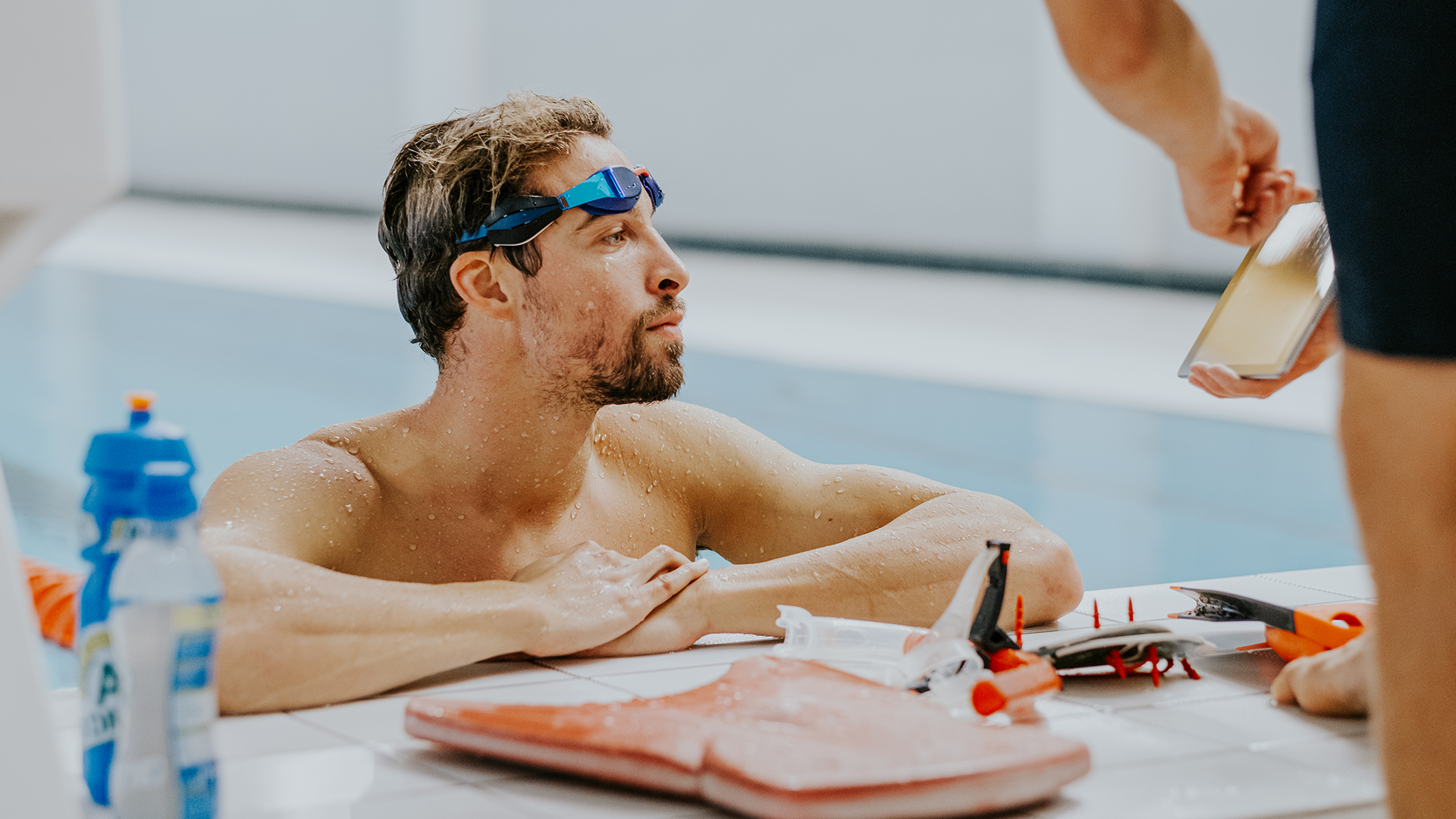
    Pieter Timmers during practice.

    First of all, Pieter, how are you?

    I’m fine, thanks. I’m healthy and that is the most important thing, especially these days!

    How do you keep yourself busy during these strange times and with all the pools closed?

    As the Olympics won’t be happening this summer, I had 2 weeks off, but it didn’t really feel like a holiday I must say (laughs). I took the time to work in my new home and to take care of my almost 3-year-old daughter. Her school is also closed so she stays at home and is a hand full. She joined me to a couple of video workouts: sometimes fun, sometimes extremely heavy (laughs).

    Are you into some other sports now that swimming is put on hold?

    Unfortunately not. Watching sports is difficult as almost everything is shut down and about doing another sport: working out during renovation works, does that count? (laughs).

    Of course, swimming is the main focus and has been for a long time. How did you get into swimming and where did it all start?

    It started at ‘De Beringse Tuimelaars’, in a 20-meter pool, when I was a 4-year-old. That was my first club in Limburg, Belgium, where I stayed until I turned 21: quite a unique story as a lot of swimmers become professionals in their teenage years already. But I just swam for fun and to spend time with my friend. Until I was 18 and I realised I swam almost as fast as the fastest Belgians who trained 30 hours in the top sport school, while I just swam max 6 hours per week. I decided to get my bachelor’s degree first and moved to the Netherlands (PSV Eindhoven) afterwards to train fulltime. With result because my times became better and better in a short period of time. After 2 years I moved to Belgium again to train with Ronald Gaastra, Olympic medal winning coach, and 1 year later I already qualified for the Olympics in London. I placed 12th in the 100 freestyle and with the relay team 4×100 we finished 8th.

    That is quite an unusual story! But it seems that the career path you took really paid off because you have achieved a lot in the sport, what would you say is your career highlight so far?

    For sure my silver medal in the 100m freestyle at the Olympic Games in Rio in 2016!

    Glad you’ve brought up the Olympics because they were all over the news the last few weeks. What is your take on the fact that the Olympics have been postponed?

    It tough for me as the Olympics would be my last race. So, this decision has a major impact on my life and agenda. But I understand the decision. Health goes first and I’m happy to be healthy.

    One thing that will resume soon is training. You must have done a lot of different types of training in your career. Which type of training is your favourite?

    That’s easy. It has to be a sprint training with vertical kicks combined with making turns and under water kicks.

    And your least favourite?

    An anaerobic training followed by 4×1000.

    While we’re talking about training: How important do you think new technology can be for swimmer’s preparation for the Olympics next year?

    I think the difference can be made by using new technology. Everybody started being well prepared for the Olympics this summer so thanks to postponing the Olympics, swimmers have more than one year extra to finetune everything and to gather lots of information about their technique in order to improve every detail. In swimming, every hundred of a second counts as that can really make the difference in winning gold or becoming 6th.

    Speaking of new technology, which influence do you think Swimtraxx One will have on your workouts and results? And on the swimming world in general?

    Swimtraxx One really is an asset and is my second coach. The extra information I can gather with the Swimtraxx One, will help me to finetune really every move and stroke. Thanks to Swimtraxx I will be able to monitor my heartrate during sets so I can train specifically in specific heartrate zones.

    “Swimtraxx One really is my second coach.”
    Pieter Timmers

    And what about the design itself? The feel, the look, …

    It’s very easy to strap on, which is a must I think as swimmers will be using the device multiple times a day. And once it’s put on, it’s comfortable and it stays in place. And not unimportant: it’s a very pretty design.

    Why did you decide to become an ambassador for Swimtraxx?

    The question should be: why not? Why not be the face of a product that helps swimmers to become even better, and maybe the best?

    As we are innovators our self, we are always happy to see the sport evolve more and more thanks to new competition formats such as the ISL. As you have competed in the first ever edition of the ISL, how do you look back on it?

    Really good. It was about time swimming became professionalised the way other sports are. Like the Diamond League in athletics and the Champions League in soccer. Swimmers train their asses off, and really get rewarded for that through the ISL. Thanks to ISL, swimming can evolve, and athletes get even more credit and respect for living their lives the way they do.

    Racing in the ISL looks fun and exciting, with the new season coming up you can end on a fun note. Although, you must be looking forward to it with mixed feelings?

    Not really, all fun to me! Looking forward to both, racing again at the ISL and to the end of my swimming career. It’s been a long run and I’m happy and grateful for all the opportunities I got and the choices I made. Now it’s time for a new chapter and some more quality time with the family.

    After the announcement of your retirement it seems that the European Championships in Budapest will be your last big tournament. What are your expectations and goals, given the current circumstances and perhaps the lack of preparation?

    It’s difficult to look forward to Europeans as we don’t know yet if the event will be scheduled as planned now due to the Covid19-crisis. Last month I couldn’t swim because the pools were closed, so that’s not really the best position to start with. But I think almost every swimmer had the same problem last month. Today I started training again, but it’s hard to say after only one day what I will be able to do in the pool in August. I dream of the gold medal. I won already 10 medals at Europeans but he only one missing is a gold one. Last Europeans I was in a very good shape and gold was achievable, but the night before leaving for Europeans, I suffered from meningitis and I had to spend the week in the hospital. Now I’m out for revenge.

    If you could handpick the 100m freestyle finalists in Budapest, who would be there with you?

    • Morozov
    • Manaudou
    • Scott
    • Grinev
    • Lobanovski
    • Miressi
    • Bilis

    Can we expect huge celebrations after your last race?

    The Flemisch Swimming Federation will organise something to honor me and for myself: I’m not a party animal that will be out drinking and clubbing immediately. But for sure I will spend time with my friends and family next year.

    We only have one more question. What does the future hold for Pieter Timmers?

    That’s a good question. As long as I will be swimming, there is just no time to think about that. When I swim, I’m 100% into that and nothing else matters. But I’m sure everything will fall into place. And I’m not going to quit training immediately, because that would be very unhealthy after years and years of topsport.

    Thank you for your time Pieter! We are looking forward to seeing you back in the pool with a Swimtaxx One right by your side.


    Used by Olympic swimmers

    Swimtraxx One is trusted by professional athletes and coaches worldwide.

    Not ready yet? Stay in the loop:
  • Femke Heemskerk: 'Swimtraxx technology measures what you feel in the p

    We caught up with our Dutch Ambassador Femke Heemskerk, all the way from California. While soaking up the Californian sun, sitting by the pool (no surprise there) she answered our questions. We asked her about the married life, the postponement of the Olympics and how she will implement technology in her workouts up to Tokyo 202One.

    Femke is one of the best Dutch swimmers of her generation and has quite the list of achievements to back it up. She started her international career in Montreal in 2005. Her first successes came by swimming for the Dutch relay team. Silver and gold in the European championships in 2006 and 2007 and a bronze medal in the World championships in 2007 were the first medals she added to her resume. She went on to win 9 European championship titles and 9 world championship titles, short and long course combined. Her biggest success is the gold medal she won with the 4x100m relay team during the Olympics in Beijing. To top it all off she is the current national record holder in the Netherlands for 5 disciplines.

    Femke Heemskerk

    First of all, how are you Femke?

    Given the circumstances I’m doing very well thank you. I’m home with my husband in California. We have more space here; the sun is treating us well and I am able to do all my alternative workouts!

    As a newlywed, congratulations by the way, how have your first weeks of marriage been?

    Well we got married 6 months earlier than planned so I could cross the USA border and be here with Guido. So, the “marriage” was very rushed and nothing more than a signature… We still want to celebrate in September! The first weeks were all about adjusting to the new situation. I had a lot of stress from the travel and the news about the virus itself. But I wouldn’t want to spend this quarantine with someone else, so we’re good!

    Must have been a crazy couple of weeks! Given the weird times we are living in right now, how are you filling your days at home?

    For the first time in my life I became a “snoozer”! Normally when the alarm goes off, I’m out! Now I can wake up at 7 and still be in the bed till 9!! Kind of loving these slow mornings. I’ll start my workouts with drylands and shoulder exercises following strength session. In the afternoon I’ll swim a little bit with Elastic followed by a hike or cycle session. I’m cooking a lot more recipes that I’ve never done and I’m reading a lot! After dinner we watch a Netflix episode.

    Even with the slow morning that looks like an active day! But now that swimming is on hold for a while, which other sports are you enjoying right now?

    Here in California we can do beautiful hikes so I’m enjoying those the most! Guido and I made a “home-gym” and I enjoy working out there as well.

    We can imagine hiking and cycling being a welcome change, but of course you live and breathe swimming. When and where did it all start?

    I guess I’ve always loved the water. I learned to swim at a very small club in my hometown, I got scouted when I was 12 and from there it all changed! When I was 11 and I saw Pieter Van Den Hoogenband and especially Inge De Bruijn winning all those gold medals in Sydney, I said to my mum “I want to go to the Olympics!”.

    Well you have come a long way since then. What would you say is your career highlight so far?

    Oof that’s a hard one! It would be easy to pick the Olympic Gold medal from Beijing. I think my career highlight would be that I’m still improving myself and still enjoying myself in this sport. And of course, my world title in the 100 free in 2014 is definitely one of my highlights!

    While we are on the topic of the Olympics, a very hot topic for the past few weeks, the games in Tokyo will be your fourth Olympics. Are you still excited? Or does it feel more like “part of the job?”

    Oh no! Definitely not “part of the job”! I’m still very excited! Every edition of the Games is different and each one has their charms. I’m very much looking forward to this one, because the Japanese are so good at organizing events!

    It’s good to still see the excitement you have for the Olympics. It must have been strange to see them being postponed. What is your take on the fact that the Olympics have been postponed?

    I felt very relieved, because now we can keep on breathing and have time to re-prepare. There was no better option, and totally out of my hands so I just have to go with it. I realize I will have some hard moments to come, but I’m willing and eager to give my best in Tokyo!

    Have you already drafted a plan for the coming year to be fully prepared for the Olympics 2020ne?

    Not yet, we have no information yet about qualifications etc. My plan is to stay fit mentally and physically as best as I can.

    Staying fit of course means training, which type of training do you like the most?

    Swimming of course, but I do like road-biking and hiking too!

    How important do you think new technology will be in your training schedule leading up to the Olympics?

    Technology allows you to measure what you feel in the pool. Yes, read that again! In swimming it’s all about water feeling, a little change in a hand movement can change a lot. So, if we use Swimtraxx technology to give me more info on what I’m actually doing, I’m sure I can improve my stroke!

    “Swimtraxx technology allows you to measure what you feel in the pool.”
    Femke Heemskerk


    On the topic of new technology, which influence do you think Swimtraxx One will have on your trainings and results? And on the swimming world in general?

    Like I said before, I believe I will get so much more information about what I’m actually doing and combining that with my own feeling will be an amazing tool for me to work with!

    Why did you decide to become an ambassador for Swimtraxx?

    First of all, I believe in the product. I have been swimming for so many years already that I need to search for little details to improve, I believe Swimtraxx One can help me with that. Also, I felt a connection with the developers of the product, which always makes it more fun to collaborate!

    You said you felt a connection with the developers. Swimtraxx is a start-up from and for swimmers. Did that play a part in your decision?

    Of course! I think this is a great advantage. I think the background in swimming also means that they know what a good size for the device for example could be, so it won’t irritate the swimmer. This is just a small example, but there are many more when you know the ins and outs of swimming.

    As innovators we also keep an eye on the development of the sports in general. Last year there was the very first ever ISL where you competed in, how do you look back on the previous one?

    I loved it!! So much energy! For me as a swimmer it was amazing to participate, but I also had so many people telling me they saw it live on Eurosport and loved to watch it! That’s great news, because we aren’t that visible. And to win the first ever ISL felt sooo good!

    What are your expectations for the new season? We assume you’ll be competing again, given you’re the defending champion with Energy Standard?

    Due to the coronavirus they have changed their schedule already, I think we have to be patient to see how the virus reacts on quarantine and how society will open up again. It’s hard to tell. Patience is what we all need. But I teamed up with Energy Standard again!

    With new competitions like ISL, do you enjoy swimming more than you did a few years ago?

    It’s not that I’m enjoying it more, but these competitions are definitely a positive change to the swimming world! They were so exciting. So much adrenaline. The Skins in the end made sure there isn’t a winner already after day 1 of racing because they involve so many points. The fact times aren’t that important and the main goal is to score points is definitely something new and refreshing. I also love the international spirit in all the teams, I get to meet so many new swimmers and to me that’s very inspiring.

    Sounds to us that you enjoyed yourself and we hope to see you back in the pool again soon! Thank you for your time Femke.


    Used by Olympic swimmers

    Swimtraxx One is trusted by professional athletes and coaches worldwide.

    Not ready yet? Stay in the loop:

  • Thoughts on how to drastically reduce the Covid-19 death toll

    Active lifestyle and Covid-19: does the cure start before the disease?

    The answer is most probably yes, as this blog will show. Let’s start off with some facts about Covid-19.

    1. Comorbidities and Covid-19

    “A comorbidity is the presence of one or more additional conditions co-occurring with a primary condition.”

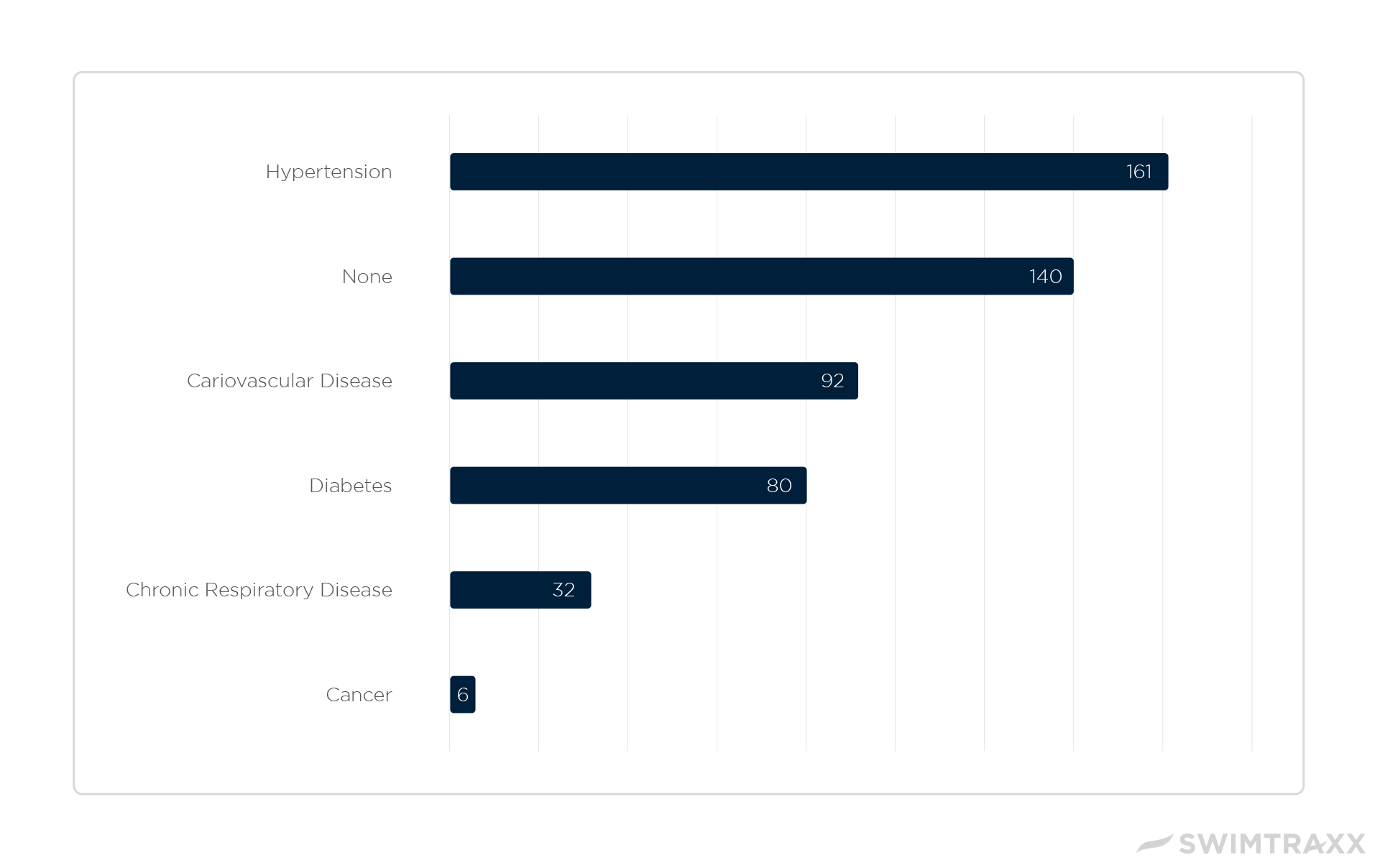
    The World Health Organization (WHO) has reported in February on the impact of comorbidity on the death rate (=deaths/case) of Covid-19. The report was based on 44,600 confirmed cases. For 20,812 cases, underlying conditions were documented. Of those cases, 511 (1.1%) cases lead to a fatality with following comorbidities:

    Comorbidities and Covid-19 fatalities (Source: WHO)

    The data shows that:

    • One third of the fatalities suffered from hypertension,
    • an other third suffered from cardiovascular disease and diabetes,
    • and the last third suffered from other or no comorbidities

    These numbers were reported over all ages. An in-depth analysis of the relation between age, Covid-19 fatality and comorbidities should be performed with worldwide data as well as they become available.

    Recently, the relationship between being overweight and Covid-19 in the ICU has been highlighted in a recent Dutch study as well. Up to 80% of Covid-19 patients in the ICU are overweight. Data in Belgium seems to confirm this hypothesis as well, with 7 out of 10 Covid-19 patients in the ICU being overweight. This while the prevalence of overweight in the general population is 40-50%. Which is a dramatic number by itself.

    2. Chronic disease in general

    “Chronic diseases represent a major share (77 %) of the total burden of disease in Europe and are responsible for 86 % of all yearly deaths”.

    Research is clearly needed that investigates the effects of chronic disease on Covid-19 fatalities and the avoidable deaths related to the co-occurrence of both.

    Around 700 billion€/year is spent in the EU on chronic diseases, which represents up to 70-80 % of a country’s total health expenditure. The rise in chronic diseases are putting an increasing strain on health and social systems in the EU and on the health and well-being of EU citizens. [source]

    3. How to reduce the risk of chronic disease

    There are 4 widely accepted measures that drastically reduce the risk of getting a non-communicable disease such as diabetes and cardiovascular disease:

    • No smoking
    • No (or limited) alcohol consumption
    • Healthy eating habit
    • Active lifestyle

    Scientific research reports that investing in healthy lifestyles that avoid overweight and include physical activity lead to a significant reduction of up to 70% or even up to 90% (diabetes II) of disease incidences for certain lifestyle diseases or non-communicable diseases. [source]

    Conclusion

    There seems to be strong evidence for a relationship between the lack of healthy lifestyle and a large number of Covid-19 fatalities. This has also been the case for the regular flu. Pressure on our health care system and on human well-being is still at high levels due to unbalanced lifestyle habits. More effort should be invested in researching and battling this issue.

    With health care budgets increasingly under pressure, focus is put on curing patients. Rightfully so. However, if we want to reduce the incidence of chronic diseases, we need to start to invest more in prevention now.

    In countries such as The Netherlands and Australia, sports and health ministries are combined into one department. This fully makes sense, yet sports is more often viewed as part of youth and entertainment than a part of health. In countries such as the UK and Belgium, sports is housed differently, in departments related to Culture, Youth and/or Media.

    As we showed above, physical activity is a key health factor and can prevent many avoidable deaths. It can also relieve pressure on the healthcare budget, creating opportunities to invest even more in curing patients. It’s a matter of choice.

    The societal value of sports is often understated. Good health and well-being is the number three goal of the EU’s 17 sustainable development goals (SDGs) and sports should play a very prominent role within it.

    Let’s start understanding that living a healthy and active lifestyle is key to a sustainable health care system and many more positive effects on individuals and society. Curing patients is extremely important, but keeping them healthy and out of hospitals is equally so.

    Sources:

    1. Report of the WHO-China Joint Mission on Coronavirus Disease 2019 (COVID-19) [Pdf] – World Health Organization, Feb. 28, 2020,
    2. Kuipers Cavaco Y, Quoidbach V. Public health in the EU: State-of-play and key policy challenges. European Union; 2014,
    3. Willett, Walter C., et al. “Prevention of chronic disease by means of diet and lifestyle changes.” Disease Control Priorities in Developing Countries. 2nd edition. The International Bank for Reconstruction and Development/The World Bank, 2006.

    Disclaimer: this article does not contain medical advice, nor is it any kind of advice that supersedes the guidelines and regulations set forth by your government. It merely illustrates scientific facts related to preventable death and an underexposed hypothesis on this topic and its relation to the recent Covid-19 virus outbreak. This piece also does not, in any way, provide an opinion or view on measures making sure the health care systems do not collapse due to a high level of hospitalizations due to Covid-19. Follow the guidelines of your government.

  • What to keep in mind when training your underwater time?

    The time to perform a lap consists of several components. You can calculate lap time using following formula: Lap time = Underwater time + Turn time + (stroke count / stroke rate).

    Figure: the laptime breakdown.

    In previous blogs, we discussed turn time, stroke rate, and stroke count. Today we take a closer look at the last parameter that is needed to calculate lap time, namely underwater time.

    Free style, back stroke, breast stroke, and butterfly are the 4 most known, and used, strokes. But, there is a 5th stroke, that needs a lot of attention and practice while training. This 5th stroke concerns the underwater stroke, also known as the dolphin kick. Training your dolphin kick will improve your underwater time.

    Underwater
    Figure: In butterfly and breaststroke, turn time starts when you touch the wall.

    Underwater time is the phase, in the beginning of a lap, that you enter after a turn and push-off. It is the time you spend under water between this push-off and doing your first stroke. This underwater time is very important because it takes up a large part of your total lap, especially in a short distance pool (25m). The proportion of the underwater time versus total swim time is way bigger in a 25m pool than for instance a 50m pool, that is why the main focus of this blog will be the short distance pool.

    In races you can swim up to 15m underwater. The aim is to reach this mark as close as possible. The ratio 15m of 25m is very big, that is why it is such an important skill to control. When looking at a 50m pool, the swimming time becomes more important, because the ratio 15m of 50m underwater is way smaller. Depending on which pool you are going to race, you should focus on training your swimming time or underwater time. Of course, by mastering both skills you will become a great swimmer.

    Why train underwater time?

    When swimming underwater, the body experiences less resistance. Because of this, a swimmer is able to swim fastest underwater. That is why you want this distance to be as long as possible. By training your underwater time the distance you swim underwater will gradually increase. Besides swimming a long distance underwater, you want to be able to swim this distance as fast as possible. This can also be trained. Optimize your underwater time to the point where you need the least time to swim your longest distance underwater. Make sure to use a good push-off to set you of a wall, because this will give you momentum you will need during the underwater time.

    Technique drill.

    Controlling your breathing is an important aspect of mastering your underwater time. Because this phase takes so much effort, you would normally be out of breath quite fast and would not be able to make a long underwater time. By training to control your breath, your underwater time will improve. A great way to train this is by using a drill. This drill is made out of 4x 75m in a 25m pool, while performing a stroke of choice.

    • First 75m – 25m underwater + 50m swimming

      Begin the underwater phase starting from the wall. Swim the last 50m with perfect turning points.

    • Second 75m – 25m swimming + 25m underwater + 25m swimming.

      Swim 25m with a perfect turning point, then go into underwater phase, and finish off with 25m swimming. This will be harder than the first 75m because you first swim 25m before going into your underwater phase.

    • Third 75 – 50m swimming + 25m underwater

      You have 2 turning points before entering the underwater phase.

    • Fourth 75m – normal swimming with after every turning point 15m underwater.

      Swimming steadily, with after every perfect turning a new underwater phase.

    Between every set, there is a rest period of approximately 10 to 20 seconds, depending on your personal level of swimming. Aim to reduce this rest time bit by bit. Besides this, try to build up your underwater time, going from 10m to 25m. Executing this drill will help train and improve your underwater time. However, it is important to understand that underwater time measures the proportion of the time you spend underwater compared to the total swimming time. The outcome of this proportion will decide whether to focus more on one parameter, rather than the other, during training.

    Take home message

    It is important to understand that underwater takes time to train. If, in the past, you lasted for instance 3m underwater, don’t expect to swim 15m underwater during a race without practice.It takes time and dedication to improve underwater time, and to get control over your breathing. Because this can get quite tough, using a drill will help you with this training. Performing a good push off the wall will create momentum that will benefit your underwater time. Train for an increased underwater distance, and to decrease the time spent on this distance.

    Swimtraxx One can measure underwater time in real-time. Because every breakout counts Swimtraxx One helps you get a clear view of your hypoxic effort for every lap. Swimmer and coach can find all the measured data on the Swimtraxx app. This gives the opportunity to focus on swimming and underwater technique rather than having to collect the data yourself.


    Track your training with real data

    Swimtraxx One measures heart rate, stroke rate, pace, and more — right on your goggles.

    Not ready yet? Stay in the loop:

  • Fast turns – the secret to a faster lap

    The time to perform a lap consists of several components. You can calculate lap time using following formula: Lap time = Underwater time + Turn time + (stroke count / stroke rate).

    TurnTime Formula
    Figure: the laptime breakdown.

    In our previous blog we discussed stroke efficiency, which consists of stroke count and stroke rate. In this blog we take a closer look at turn time and why it is important to pay attention to this parameter.

    Turn time is an important aspect of your total lap time. Turning is the process of changing direction at the wall to keep swimming continuously. It’s a technique that is used in every stroke: freestyle, backstroke, breaststroke and butterfly. Often, swimmers wrongly use the walls as a moment of rest. By doing this, your overall lap time will increase, which will set you back from accomplishing your full potential. You can use the walls in such a manner that they decrease your turn time and thus decrease your total lap time.

    Figure: In butterfly and breaststroke, turn time starts when you touch the wall.

    There are two main variations of turn technique depending on which stroke you are performing. For butterfly and breaststroke, turn time is defined as the time between touching the wall with your hands and your push off. This is also known as an open turn. For backstroke and freestyle, turn time is defined as the time between initiating your tumble turn and your push. We call this a flip turn.

    Figure: For all strokes, turn time ends at the push off from the wall.

    Why train your turn time?

    By performing one continuous motion, a good turn will prevent you from having to stop at the wall. This will save you a lot of time, which can be very precious when doing a race. Therefore, improving your turn time will improve every lap, which will result in you improving your personal best. Keep in mind that a fast turn time needs to result in a good push off. This push off will be the start of your new lap. A fast turn time should thus be executed in a controlled manner. At the end of the turn, your feet should be positioned in the right way against the wall in order to initiate this perfect push off. We will go into this in a later post. A strong push-off will benefit the rest of your swimming course, and again, improve your lap time. Besides this, having a good turn time will offer several advantages.

    PushOff

    Advantages.

    The first and most obvious advantage turn time offers is that it makes you faster. This is mainly the result of a good push off, which comes after a good turn time. Besides this, a turn is a very efficient way to keep swimming without interruption. Moreover, it allows you to build endurance. Because you swim uninterrupted without resting, the time you normally take to stop at each wall can be eliminated. Other than the above, a good turn time can benefit breath control. During a turn, you do not have time to stop and take a breath, which means that if you train your turn time, your breath control will automatically improve. The ability to control your breath will be of use during your race, and it will allow you to swim at a much higher level.

    How to train turn time ?

    An efficient way to train and get a fast turn time is to use a tumble drill. While swimming a lap, add turns without a wall at every 12.5m point. Start of to do so by tucking in your head and knees to create a rotation. Try to get as much rotational momentum as possible out of this. The aim is to make the rotation as fast as possible. Depending on what stroke you are performing, your rotation will go forward (backstroke and freestyle) or backwards (butterfly or breaststroke). Attempt to generate an amount of rotational speed that results in two rotations instead of one. ​ In later blogs we will go further into detail on how to perform the perfect turn for each stroke.

    Take home message.

    Having a good turn is very important during a swim. This will lead to an improved turn time, which will benefit you during your race. Your rotation should be controlled and fast. When performing a turn, make sure to also focus on your push-off, because this will result in speed for the rest of your upcoming lap. Use a different turn technique depending on which stroke you are performing.

    Swimtraxx One offers you turn time information in real-time. This makes it possible for a swimmer to track the rotational speed of every turn during their swim. You can now focus on perfecting your turn time without having to collect any data yourself.


    Track your training with real data

    Swimtraxx One measures heart rate, stroke rate, pace, and more — right on your goggles.

    Not ready yet? Stay in the loop:

  • Why a higher stroke rate is not necessarily a better one

    The time to perform a lap consists of several components. You can calculate lap time using following formula:

    lap time forumla
    Figure: the laptime breakdown.

    In the previous blogposts, we discussed stroke rate and stroke length individually. Today we will have a closer look at swim time and stroke efficiency, which consists of stroke rate and stroke count together. In order to have a shorter swimming time, speed is the parameter you should focus on and train to optimize. When looking at swimming speed following formula is in order:

    Swimming Speed Formula

    Figure: the laptime breakdown.

    Stroke rate and stroke length are intertwined​

    The first important thing to understand when training your swim time is that you need to improve both stroke count (by improving stroke length) and stroke rate to swim a faster time. You would think that just increasing both maximally would render a faster swim speed, but this is not true. The reason for this is that both parameters don’t exist independent from one another. During a swim stroke length and stroke rate influence each other and you should thus focus on getting both parameters to their full potential.

    Increase swimming speed focusing on both parameters​

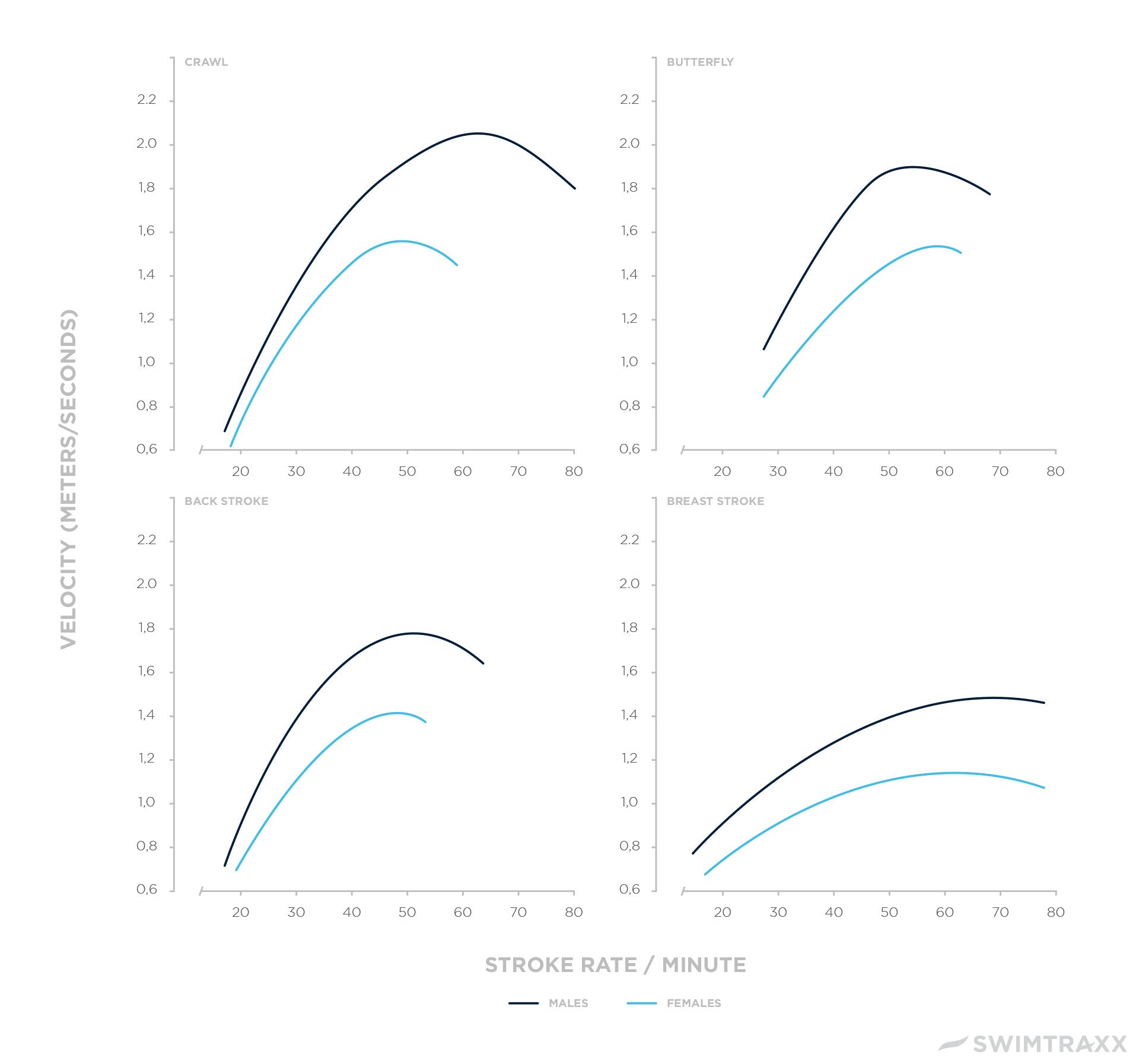
    Stroke rate and stroke length are intertwined, therefore, focusing on both parameters in the right way will result in an increased swimming speed. The graphs below show the relation between stroke rate, distance per stroke and speed. When increasing stroke rate your distance per stroke will gradually increase. However, from a certain level your distance per stroke will deteriorate again. This is because, from a certain point while increasing your stroke rate and speed, your arm movements will start to go from long and efficient, to short and inefficient. This is the turning point from which your speed will start to. The reason being is that because of the short and uncontrolled arm strokes you make, your stroke will start to ‘slip’ through the water, losing grip. By losing grip your stroke length decreases gradually. As stroke length and stroke rate need to be multiplied in order to get your swimming speed, from a certain point speed will start to decrease as slipping gets worse.

    Velocity
    Figure: The relation between stroke rate, distance per stroke and speed.
    Figure: the swimming economy model.

    A easy comparison for what happens is running. While running your legs take big steps. When you start to run faster, your legs need to move quicker. They are able to do so until a certain point when your legs can’t make such big steps while going so fast. Easily said your legs can’t keep up with the running speed anymore. From this point you start taking smaller steps again, resulting in gradually running slower. The same thing happens with swimming.

    Stroke Index


    As mentioned in our blog about stroke rate, it is important, especially for younger swimmers, to focus on stroke length, as this is an aspect of your stroke that should deteriorate as little as possible during a race. In order to achieve a faster swimming speed, it is thus key to maintain a good stroke length for an increasing stroke rate. This will improve your swimming speed as your optimum combination of stroke rate and stroke length (= your stroke efficiency) will shift to a faster swimming speed.​

    Parameters that measure efficiency​

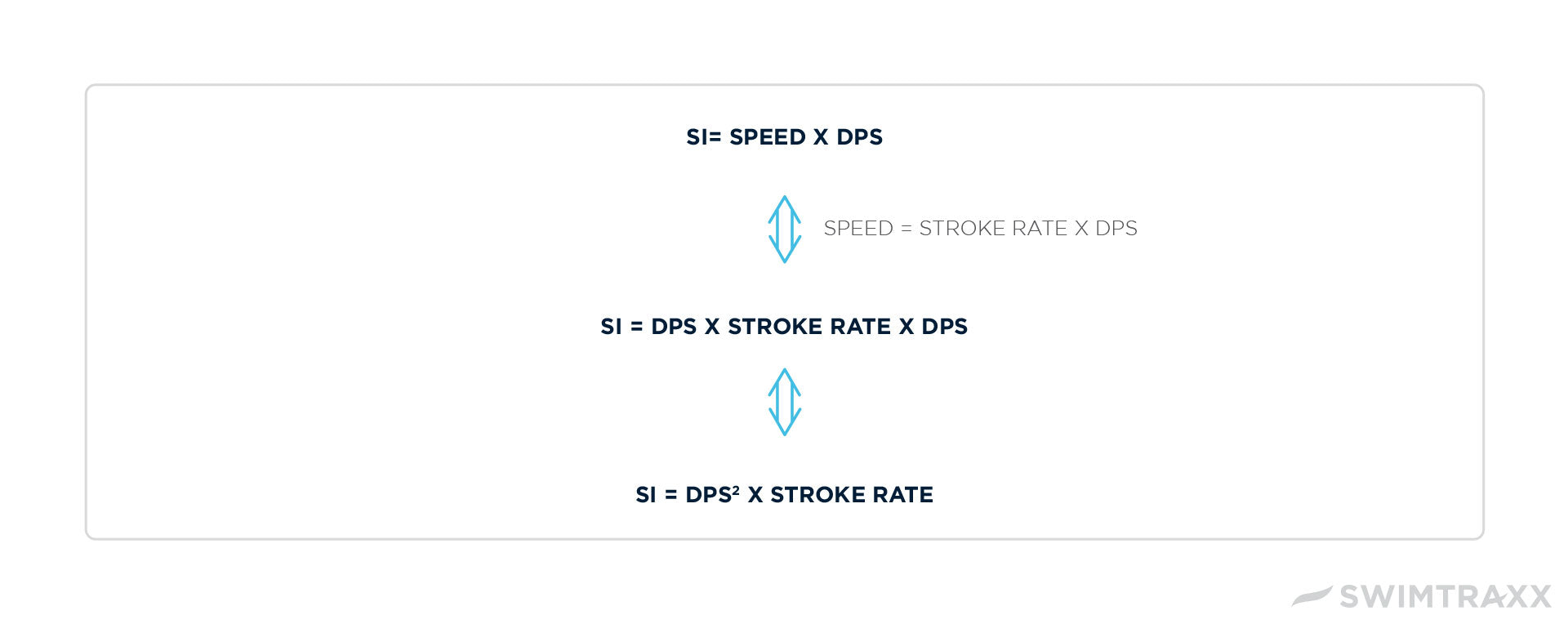
    Following are some parameters that measure efficiency​. The first formula is the stroke index:

    SI
    Figure: the stroke index formula.

    Stroke index will favor a higher distance per stroke at the same stroke rate. This means that when you increase distance per stroke the stroke index will increase twice as fast compared to when you increase your stroke rate. This is a choice of using this specific parameter. Another usable formula for stroke efficiency is SWOLF:

    Figure: Calculating your SWOLF score.

    We want to measure stroke efficiency during swimming, so we remove the turn time or underwater time from the derived formula to get swim time:

    Figure: How to measure stroke efficiency during swimming?

    Even though you can use SWOLF or stroke index to measure your stroke efficiency, it is your final swimming speed that really shows how efficient you are. How you reach this final speed does not matter. It is thus, important to note that stroke index and SWOLF are just indicators invented to give an idea of stroke efficiency. Stroke rate and stroke length are the basis for both of these parameters. These are still the two important basic working point for a swimmer to focus on when improving their efficiency. Improving stroke index or SWOLF should never be the sole focus of a workout plan as the optimal combination of a certain stroke rate with a specific stroke length is individual.

    Take home: don’t focus on one parameter.

    When improving stroke efficiency it is important to take into account that stroke rate and stroke count can not stand on their own. You should always focus on both parameters because they influence one another. There are various formulas that help you measure stroke efficiency. Though these offer help when improving stroke efficiency, these formulas should not be your sole focus. Stroke rate and stroke count are the two main elements of stroke efficiency and remain the most important focus. By improving both stroke rate and stroke count, your stroke efficiency will automatically improve as well.

    Swimtraxx One measure your stroke index for every lap you swim. With this blog we have explained that this parameter on its own will not make you a better swimmer. Focus on the combination of your stroke rate and stroke length in order to increase your swimming speed. Swimtraxx One also measures stroke rate and stroke length in real-time. This gives coaches and swimmers the opportunity to interpret their swimming efficiency correctly without having to collect the data yourself.


    Track your training with real data

    Swimtraxx One measures heart rate, stroke rate, pace, and more — right on your goggles.

    Not ready yet? Stay in the loop:

  • How to become a better ‘you’ in 2020

    With the new year just around the corner, it’s time to start thinking about your New Year’s resolution for 2020. In this blog we give away 5 habits that will help guide you to achieve your ultimate 2020 goal, followed by 5 inspiring quotes that will stimulate you mentally in becoming the best version of yourself.

    5 HABITS THAT WILL HELP GUIDE YOU TO YOUR ULIMATE GOALS

    1. Get enough sleep

    Sleep is the most important generator for energy. A good nights sleep keeps the mind and body healthy and going. The average adult needs 7 to 8 hours of sleep each night to feel rested the next day. When feeling rested, you will be able to achieve more things during the day. You will be more productive and happier, after having enough sleep.

    2. Exercise everyday

    Exercising every day will work wonders on your fitness. In the long run, this will improve your energy levels which will have a positive effect on your overall life. If you ask us, swimming is the perfect sport to exercise each day. If you don’t have time to go swimming every day, there are tons of other exercising possibilities that will help you improve your physical health. For instance, going to the gym, or even doing some exercises at home is a great solution to stay in shape.

    3. Have a goal in mind

    Setting goals will help you reach certain things in life. The process of writing your goal will clarify what you desire. Having a clear sight of what you want in life is an important motivator that will give your life a greater purpose. It is important to, once you have set them, commit to these goals. Whatever you are doing in life, don’t lose sight of what you really want. Keep your eye on the prize, this will encourage you to work hard and make them happen.

    4. Planning is key

    Just like we have seen in some of our previous blogs, it is always a good idea to have a plan in mind. This can be a yearly, monthly, or even a daily plan. Try to set short-term goals, to work up to the bigger, long-term, goal. Taking smaller steps will make it easier to make progress in completing your ultimate goal. Crossing off small steps of your to do-list is also a good motivator to keep going, because it will bring that big wish closer to you bit per bit.

    5. Realize it’s a process

    Don’t rush it. Getting to where you want in life is a process and can sometimes take time. Don’t get discouraged if reaching your goal takes a bit of time. Setbacks are a part of learning, and learning means moving forward. It is good to remind yourself every now and then on what your end destination is, and to understand that it is a process that requires hard work and dedication.

    5 Inspiring quotes


    Sometimes you just need to hear an inspiring quote to give you the motivation you need. Here are 5 of them:


    “I’d rather choke on greatness than nibble on mediocracy.”
    Author Unknown

    Strive to be the best possible version of yourself, every day. Don’t underestimate yourself, you’re almost always better than you think you are.

    “It is not death that a man should fear, but he should fear never beginning to live.”
    Marcus Aurelius

    If there is something you want or want to achieve, stop just thinking about it, start doing what it takes to reach it.

    “Life is 10% what happens to you and 90% how you react to it.”
    Charles R. Swindoll

    Everyone has to deal with a little setback at some point in their life. The difference is how you react to it. Seek to learn from your mistakes and move on to do better.

    “Comparison is the thief of joy.”
    Theodore Roosevelt

    Spend time on self-improvement rather than fascination over competitors. Reflect on your own actions rather than looking at how others are doing.


    “Selfish people end up having only their self.”
    Author Unknown

    Treat people the way you want to be treated. Respect cannot be forced, it is earned. Be kind to others, because you never know what they are going through.

    Team Swimtraxx wishes you a Merry Christmas and a Happy New Year. May 2020 bring you nothing but happiness and joy.


    Track your training with real data

    Swimtraxx One measures heart rate, stroke rate, pace, and more — right on your goggles.

    Not ready yet? Stay in the loop:

  • How to swim further with fewer strokes?

    The time to perform a lap consists of several components. You can calculate lap time using following formula:

    Figure: the laptime breakdown.

    In the previous blog we discussed stroke rate and how to swim faster when focusing on this parameter. In this blog we take a closer look at how to swim with a low stroke count. There is no such thing as ‘the right’ stroke count. If you wish to swim a long distance while doing as few arm strokes as possible, you should work on improving your stroke length. By increasing your distance per stroke, your stroke count will gradually decrease per lap. When looking at swimming speed following formula is in order:

    Figure: calculating your swimming speed.

    Distance per stroke, or stroke length, is an important aspect of speed. This parameter gives you the distance your body travels forward on each arm stroke. Having a good stroke length will result in covering more distance by doing less strokes. The main focus of this blog will therefore be distance per stroke or stroke length. We will discuss 3 stages of a stroke, followed by some additional advice.

    Stages of a stroke.

    An arm stroke can be divided in 3 stages that all need separate attention.

    First up are your entry and catch. The first phase of an arm stroke is the moment your hand enters the water. With every stroke, whether it’s freestyle, backstroke, butterfly or breaststroke, the catch phase is the moment your hand starts the propulsive motion through the water. You want to enter this phase as early as possible during your stroke. This will create a propulsion from a very early stage in your arm stroke and this will set the course for the rest of your stroke. After this, it is time to work on your pull. This is the biggest and longest part of your swimming stroke and requires the largest muscle activation. During this stage your aim is to pull your arm through all the way backwards, towards the last phase of your stroke. Do so by creating a 90° angle between the upper and lower part of your arm. It is important to have a feel for the water, because this will result in a very efficient stroke. You can work on your pull using tools such as a pull buoy or paddle. These will also increase your strength.

    Another technique that is also very effective on training your pull is sculling. While sculling, you create small and quick forearm movements that create propulsion. Sculling is a very good way to improve your feel for the water in any phase of your arm stroke. Using this technique to improve your pull will also improve your strength.

    Lastly, you should finish your stroke. During this stage, especially for butterfly, freestyle and backstroke, you should aim to finish your stroke at the hips and rotate them all the way back until your arms are completely stretched out. By doing this, you will use your maximal arm length to create propulsion within your stroke. Don’t pull out your arm too early but push it out right until the end.

    Importance of leg kick.

    When talking about distance per stroke a lot of people naturally start focusing on their arms. But, having a good kick is equally important for having a good stroke length. Because kick helps you propel throughout your stroke, it effects your total stroke. Besides this, it also supports your arms in actually getting a good stroke length.

    Take home message.

    Remember that stroke length is something individual. It takes time and practice to achieve a good stroke length. Work on all phases of your stroke in order to achieve a maximum distance per stroke. While doing so, don’t forget that your legs are a second important source of propulsion in your swimming stroke. Lastly, remember that sculling is a good drill method to improve your feeling for the water in any phase of your arm stroke. ​ In the future we will discuss more drilling techniques to improve different phases.

    Swimtraxx One can help you train your stroke length because it measures the exact information in real-time. You will have a clear idea of what is still required in order to achieve a good stroke length. In our next blog, we will extend this series by focusing on stroke efficiency. Even though stroke length is an excellent factor to build on, you should always take stroke efficiency in consideration.


    Track your training with real data

    Swimtraxx One measures heart rate, stroke rate, pace, and more — right on your goggles.

    Not ready yet? Stay in the loop: